Flooring: Durability Versus First Impression
Rental grade flooring is almost always luxury vinyl plank or a comparable resilient product, chosen because it tolerates moisture, scratches and repeated moves in and out without showing damage, and because a damaged plank can be replaced in isolation without refinishing the whole floor. It costs less per square foot installed than most alternatives and its replacement cycle is measured in tenant turns rather than years, which is exactly the metric that matters for a held rental property.
Retail grade flooring more often means engineered or solid hardwood, or a higher end tile in wet areas, chosen because resale buyers read wood flooring as a signal of overall home quality in a way that vinyl generally does not achieve regardless of how convincingly it mimics wood grain. The tradeoff is a higher upfront material and installation cost and a higher cost to repair localized damage, since wood floors are typically refinished or replaced in larger sections rather than plank by plank.
The crossover point is usage pattern, not just exit strategy. A short term rental with heavy turnover benefits from rental grade flooring's repairability even if the property will eventually be sold, while a property being actively prepared for sale within the next year benefits from retail grade flooring installed just before listing, when its lower durability window does not matter because a buyer will own it before wear becomes visible.
Cabinets, Counters & Paint Sheen
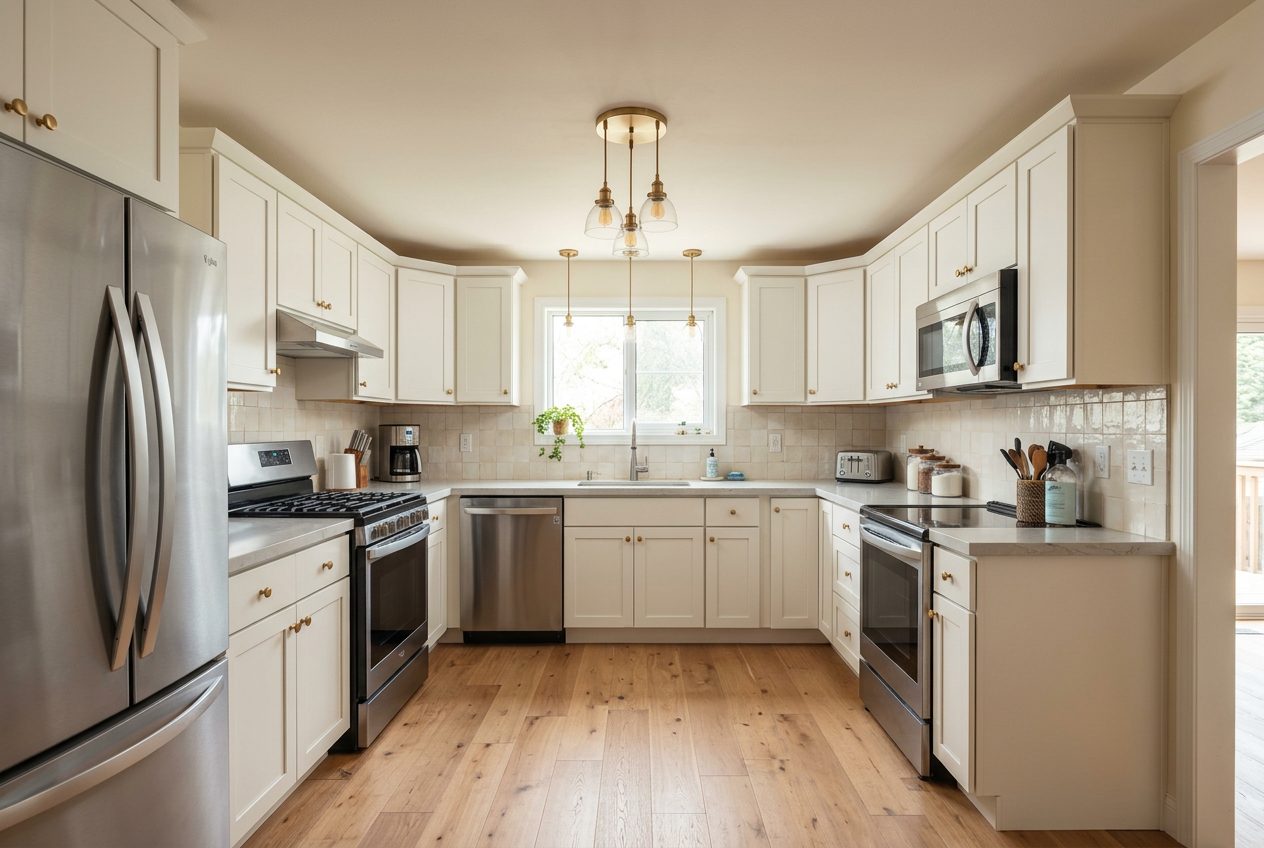
Rental grade cabinets are typically stock, laminate faced boxes with simple hardware, selected because replacement cost per unit is low and matching a single damaged cabinet later does not require special ordering. Retail grade cabinets move toward semi custom construction with better hinges, soft close hardware and a wider range of door styles, priced to match what a buyer expects walking through a kitchen they intend to live with for years rather than a unit they will occupy for a lease term.
Counters follow a similar logic. Rental grade laminate counters resist staining reasonably well, are inexpensive to replace section by section, and hold up fine under tenant use without an owner needing to worry about disclosure of every ding. Retail grade counters, typically quartz in most markets now, cost substantially more installed but are what comparable listings in a retail neighborhood are priced against, and a kitchen that shows laminate counters in a market where every competing listing shows quartz will read as behind rather than merely economical.
Paint sheen is a smaller line item individually but it compounds across a whole property. Rental grade paint is usually a flat or matte finish, chosen because flat paint is cheap, touches up easily in small areas without an obvious sheen mismatch, and hides minor wall imperfections between tenants. Retail grade paint typically moves to an eggshell or satin finish, which photographs better, wipes clean more easily for a buyer's inspection, and reads as a more finished, considered choice, at a modest cost premium per gallon and a slightly less forgiving touch up process.
- Flooring: rental grade favors repairable LVP, retail grade favors resale-recognized wood or tile
- Cabinets: rental grade favors low-cost stock units, retail grade favors semi custom construction
- Counters: rental grade favors laminate, retail grade favors quartz to match comparable listings
- Paint: rental grade favors flat for easy touch up, retail grade favors eggshell for a finished look
Fixtures & The Replacement Cycle Economics
Fixtures, light fixtures, faucets, cabinet hardware, door hardware, are where the durability and replacement cycle argument is easiest to see in isolation because the price gap per item is small but the number of items in a property is large. A rental grade light fixture might run a fraction of the cost of a retail grade equivalent, and across a dozen fixtures in a typical home that difference adds up to a meaningful line item, but the rental grade fixture is also more likely to need replacing after a few tenant cycles due to wear on cheaper finishes and mechanisms.
The economics only make sense when you actually run the replacement cycle math rather than comparing sticker price alone. A rental grade faucet that needs replacing every three to four tenant turns because the finish wears through or the cartridge fails can cost more over a ten year hold than a mid tier retail faucet installed once and maintained, even though the retail faucet cost more on day one. This is the core argument for why rental grade is not simply the cheap option, it is the option optimized for a specific turnover pattern, and outside that pattern the math can flip.
When Spending More Is The Cheaper Decision
Spending retail grade money on a held rental only makes sense in a narrow set of situations, a long hold with low expected tenant turnover, a market where higher finish quality supports meaningfully higher rent, or a unit type, like a high end single family rental, where the tenant pool itself expects and will pay for retail grade finishes. Outside those situations, retail grade spend on a rental is usually just durability nobody is paying rent to use, and the extra capital would earn a better return applied elsewhere.
The reverse mistake, rental grade finishes on a property being prepared for resale in a market where comparable listings show retail grade kitchens and bathrooms, is more commonly the expensive one, because it does not just cost the difference in material, it can suppress the sale price or extend days on market enough that the carrying cost during that extra time exceeds what retail grade finishes would have cost in the first place. Matching grade to exit strategy, not to whichever number feels smaller today, is the decision that actually saves money.
Tenant Turn Versus Resale Buyer
A tenant turn happens on a schedule you can estimate, typically every one to three years depending on lease terms and local rental market conditions, and each turn is an opportunity for wear that rental grade materials are specifically chosen to absorb without triggering a costly repair or replacement. The tenant is renting the space, not evaluating it against comparable properties for sale, so finish level beyond a baseline of clean and functional rarely moves the rent a landlord can actually charge in most markets.
A resale buyer evaluates the property once, against every other comparable listing they have toured that month, and finish quality is one of the few things a buyer can assess in a single walkthrough without specialized knowledge. That single evaluation moment is why retail grade spend concentrates value differently than rental grade spend, it is not paying for durability across dozens of future events, it is paying to win one specific comparison against competing listings at the moment that matters most for the sale price.